
Specification guard
Required fields and product rules prevent E5/E10, diesel/XTL or fuel/operating fluid from being silently treated as the same item.
Product · grade · quantity · unitA tank reading without an observation time is not dependable stock. A price curve without a delivery route is not an offer. SCF connects the measurement, requirement, price basis, approval and delivery evidence—and shows where data is missing or a forecast is uncertain.
Request a technology discussionExplore Oiliver AIEvery function carries an operating status. External data sources, meters and AI functions are connected only after technical, domain and security approval.
Required fields and product rules prevent E5/E10, diesel/XTL or fuel/operating fluid from being silently treated as the same item.
Product · grade · quantity · unitPostcode, quantity, delivery mode, date, free tank capacity and access are captured as one delivery case—not scattered emails.
Location · access · window · receiptThe marketplace compares only offers whose product, delivery basis, tax and freight treatment, validity and payment are visible.
Price · freight · tax · paymentOrganization, user role and permission determine who can see and perform a request, offer or decision.
Organization · role · limit · approvalVersions, login events, decisions and transaction evidence are attached to the correct organization and record.
Version · event · document · timeIntended for document extraction, completeness checks, forecast explanations and exception prompts. It cannot award or confirm an order.
Read · calculate · explain · hand over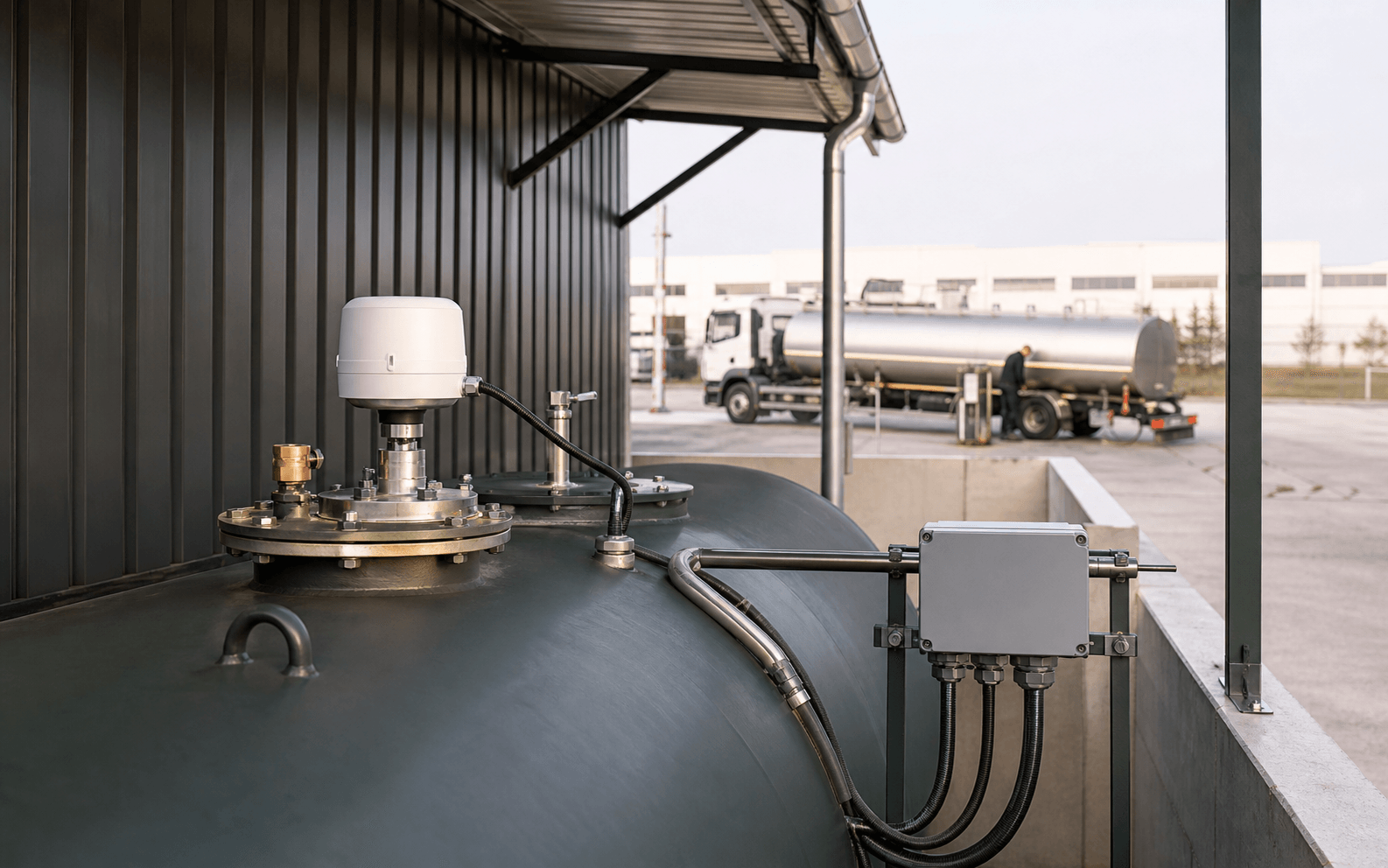
TankLink is the integration layer between approved level instrumentation and the SCF supply process. Autonomous radar sensors can transmit readings over NB-IoT, LTE-M or LoRaWAN; existing inventory platforms can expose them through a REST API. SCF attaches the data to the correct tank, product, site and observation time.
The instrument supplies distance or level plus device and quality data. Tank geometry converts the reading into a usable stock value.
Timestamp, device identity, plausibility, radio status and outliers are checked. A stale reading must never look like live stock.
Burn rate, safety stock, free capacity and real delivery lead time produce a range window—not a falsely exact run-out time.
Before the last safe ordering boundary, TankLink creates a proposal with product, target quantity, delivery point, window and rationale.
An authorised person or an explicitly agreed contract rule releases the case. After delivery, the order, approved meter value and stock movement are reconciled.
Oiliver AI is designed as a customer-specific decision module. It forecasts demand from real consumption history, tank readings, confirmed deliveries, operating plans and seasonal patterns. In parallel—where the data is licensed—it evaluates multiple market scenarios using the forward structure, price movement, volatility, FX, freight and real offers. Both meet in an explainable procurement corridor.
Readings, deliveries, drawdown and data quality for each tank.
Shifts, fleet activity, production plans, shutdowns and exceptional demand.
Site-specific patterns; for heating oil, for example, DWD weather data and degree days.
Lead time, minimum lift, free capacity, delivery window and safety stock.
Forward structure, movement, volatility, FX, tax, freight and real offers—licensed and carrying source and observation time.

It is built where the measurement, delivery route and evidence currently separate. These modules are introduced only with a clear data contract, a named system of record and a controlled operating status.
Order, ETA event, electronic delivery note, meter value and quality evidence are versioned in one record. Hand-off to a certified eFTI platform remains a defined interface; platform certification sits with the selected eFTI provider.
Tank movement, expected consumption, device health and approved delivery-meter values are reconciled. The module flags unexplained differences for specialists; it is not a substitute for required leak detection or calibration.
Range, free capacity, site hours, vehicle status and disruption are translated into a dependable receiving window. If conditions change, dispatch first sees the affected order and the next permitted option.
Sites are prioritised by supply risk; compatible requirements can be grouped by product, region and window. Freight and part-load consequences become visible before a request is released.
SCF integrates approved systems through clearly versioned interfaces. Every input retains its source, observation time, organization and quality state. Only then may it influence a requirement, offer or evidence record.
Level, free capacity, observation time, device identity and battery state
Approved delivery quantity, temperature basis and associated delivery record
Vehicle, status, time window, geofence event and exception
Order, confirmation, delivery note, invoice and master-data reference
Product, batch, document version, issuer and recipient
Approved project and operating data through separate, defined interfaces
Oiliver combines time-series forecasts, deterministic procurement rules and—optionally—language-based explanation. The language model is not the calculation basis. Every recommendation must expose its data, assumptions, range and change, and may never override an operational boundary by itself.
Measurement, source and observation time remain visible
Forecast range instead of false precision
Deliverable offer before market indicator
No autonomous order or price approval
The human decision remains recorded
Device and platform credentials are separated from user accounts. Inbound events carry device identity, time and integrity checks; replays and implausible jumps are intercepted. API secrets do not live in application code, tenants remain isolated, and privileged changes require approval and an audit trail. Direct supply and marketplace still share a brand—not access rights.
Review the security architectureSCF reviews the instrumentation, data access, tank geometry, consumption history and approval rules in a bounded integration case. Telemetry becomes an operational decision aid only after the measurement and delivery process hold together.
Discuss TankLink & Oiliver